 English
 русский
 Tiếng Việt
 Español

The metallized film capacitor has genuine, repeatable self-healing capability, while a Radial Electrolytic Capacitor does not. When a localized dielectric breakdown occurs in a metallized film capacitor, the thin metal electrode vaporizes around the fault, isolating it and restoring insulation — often with negligible capacitance loss. In a Radial Electrolytic Capacitor, the oxide dielectric can partially re-form under certain conditions, but this is a limited electrochemical process, not a true structural self-healing mechanism. Understanding this distinction is critical when choosing between these two technologies for fault-tolerant or high-reliability applications.
How Self-Healing Works in a Metallized Film Capacitor
In a metallized film capacitor, both electrodes are extremely thin metal layers — typically aluminum or zinc — deposited directly onto a polymer film such as polypropylene (PP) or polyester (PET). This electrode thickness is usually only 20–50 nm, compared to several micrometers in foil-type capacitors.
When a voltage spike or localized weak spot causes dielectric breakdown at a pinhole defect, the resulting arc discharge generates intense local heat. Because the metallization is so thin, it instantly vaporizes in a small area — typically less than 1 mm² — surrounding the fault point. This clears the short circuit, re-establishes insulation, and the capacitor continues to function. The energy required for this process is sourced entirely from the capacitor itself, with no external intervention needed.
A single metallized film capacitor can undergo hundreds to thousands of self-healing events over its lifetime with a cumulative capacitance loss often below 1–2%. This is why metallized film capacitors are widely used in AC motor run capacitors, power factor correction (PFC) banks, and high-voltage pulse applications where transient overvoltages are frequent.
The Oxide Re-Formation Process in a Radial Electrolytic Capacitor
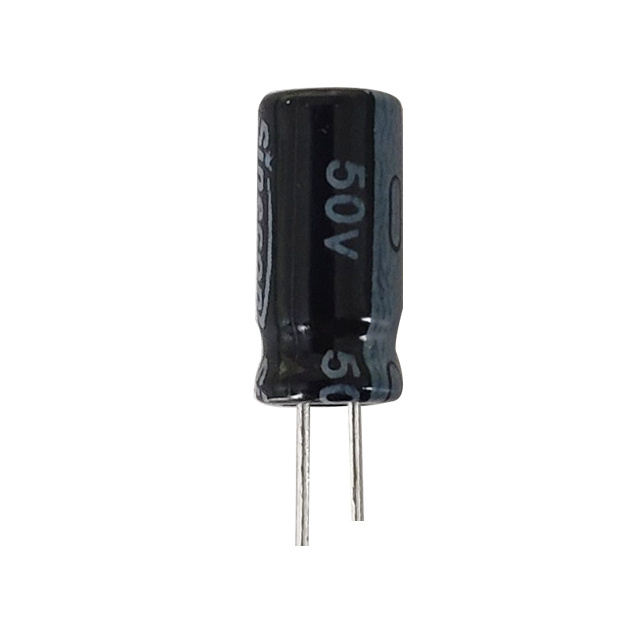
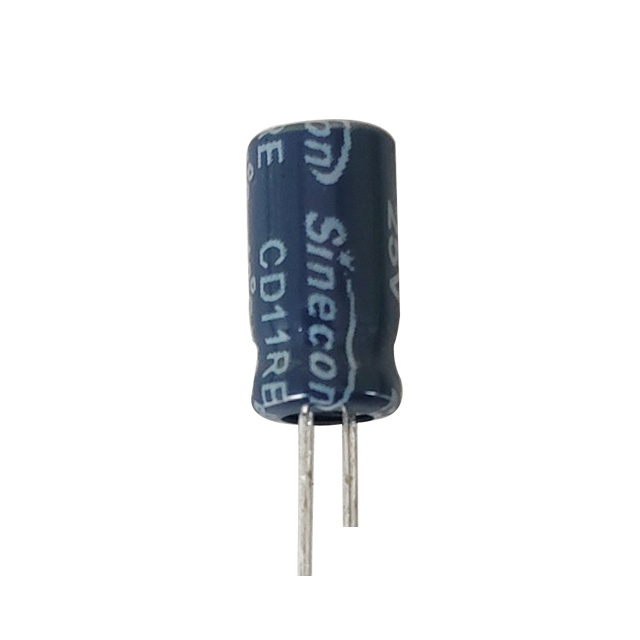
A Radial Electrolytic Capacitor uses an aluminum oxide (Al₂O₃) dielectric layer grown on an etched aluminum foil. When a minor defect or thin spot in this oxide layer is subjected to voltage stress, the electrolyte can supply oxygen ions that partially re-oxidize the aluminum at that point — effectively thickening the oxide locally and sealing small imperfections. This process is called oxide re-formation.
However, this is not equivalent to the self-healing mechanism in metallized film capacitors for several important reasons:
- Oxide re-formation in a Radial Electrolytic Capacitor only works for very minor, sub-breakdown defects. A true dielectric puncture that allows significant current flow will cause thermal damage to the surrounding oxide and electrolyte, which cannot be reversed.
- The re-formation process depends on the availability of active electrolyte. As the Radial Electrolytic Capacitor ages and electrolyte evaporates (especially at elevated temperatures), this limited re-formation capability degrades further.
- Re-formation is a slow electrochemical process, not an instantaneous arc-clearing event. It does not protect against fast transient overvoltages in the way metallized film self-healing does.
- Repeated voltage stress on a Radial Electrolytic Capacitor causes cumulative oxide degradation, increasing leakage current over time — the opposite of what self-healing achieves in film capacitors.
Side-by-Side Comparison: Self-Healing Capability
| Parameter | Radial Electrolytic Capacitor | Metallized Film Capacitor |
|---|---|---|
| Self-healing mechanism | Oxide re-formation (electrochemical) | Metallization vaporization (thermal) |
| True self-healing? | No — only minor defect repair | Yes — clears active faults |
| Response speed | Slow (seconds to minutes) | Instantaneous (microseconds) |
| Capacity for repeated events | Very limited | Hundreds to thousands of events |
| Capacitance loss per event | Potentially significant | Typically <1–2% cumulative |
| Failure mode after fault | Increased leakage, thermal runaway risk | Graceful capacitance reduction (open-circuit fail) |
| Dependency on aging | Re-formation weakens as electrolyte depletes | Not dependent on electrolyte |
Failure Modes: Why the Difference Matters in Real Circuits
The absence of true self-healing in a Radial Electrolytic Capacitor has real-world consequences for circuit safety and longevity. When the oxide dielectric of a Radial Electrolytic Capacitor is breached by an overvoltage event, the resulting leakage current generates heat inside the component. This accelerates electrolyte vaporization, builds internal pressure, and — if the vent mechanism is overwhelmed — can lead to electrolyte leakage, bulging, or in extreme cases, rupture.
By contrast, when a metallized film capacitor undergoes a self-healing event, the fault is cleared in microseconds, the component temperature barely rises, and the circuit continues operating. The capacitor's failure mode is a gradual, predictable capacitance decrease — an open-circuit fail-safe — rather than a potentially destructive short-circuit event.
This is a key reason why safety-critical AC applications — such as motor run capacitors, lighting ballast capacitors, and grid-connected PFC systems — almost exclusively use metallized film capacitors rather than Radial Electrolytic Capacitors. Standards such as IEC 60252 (motor capacitors) and IEC 61071 (power electronics capacitors) specifically recognize self-healing behavior as a required safety property.
Where the Radial Electrolytic Capacitor Still Excels Despite This Limitation
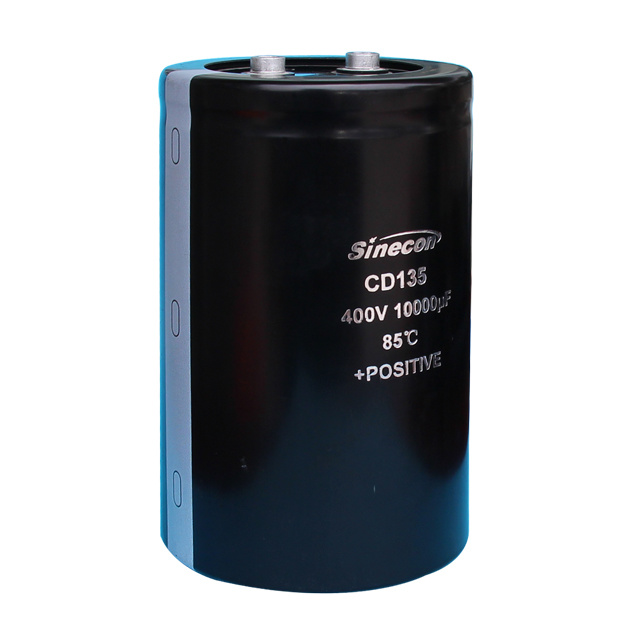
The lack of self-healing does not make the Radial Electrolytic Capacitor an inferior product overall — it simply defines its appropriate application space. The Radial Electrolytic Capacitor outperforms metallized film capacitors in several critical areas:
- Capacitance density: A Radial Electrolytic Capacitor can deliver 1000 µF in a package that a metallized film capacitor could not approach at the same voltage rating, even with advanced winding techniques.
- Cost per µF: For bulk capacitance in DC power supplies, the Radial Electrolytic Capacitor remains far more economical than any film alternative.
- High voltage DC filtering: In SMPS designs operating at 400V DC bus, a Radial Electrolytic Capacitor provides the required bulk storage in a compact footprint — an application where metallized film capacitors would be physically impractical at equivalent capacitance values.
- Stable DC bias performance: Unlike MLCC ceramics, the Radial Electrolytic Capacitor does not suffer severe capacitance loss under DC bias voltage.
The key is matching the technology to the application: use the Radial Electrolytic Capacitor for DC bulk storage and filtering where voltage is controlled and transients are managed by upstream protection; use metallized film capacitors where AC stress, repetitive transients, or fail-safe behavior are required.
How to Protect a Radial Electrolytic Capacitor in the Absence of Self-Healing
Since the Radial Electrolytic Capacitor cannot self-heal from overvoltage events, circuit designers must compensate through external protective measures:
- Voltage derating: Operate the Radial Electrolytic Capacitor at no more than 80% of its rated voltage under worst-case conditions, including load transients and supply tolerances.
- Transient voltage suppressors (TVS): Place a TVS diode or metal oxide varistor (MOV) across the Radial Electrolytic Capacitor in circuits prone to voltage spikes to clamp transients before they stress the oxide layer.
- Series resistance or soft-start circuitry: Limiting inrush current during power-up reduces mechanical and electrochemical stress on the Radial Electrolytic Capacitor's oxide at startup.
- Temperature management: Elevated operating temperature accelerates electrolyte evaporation and reduces whatever oxide re-formation capability remains. Keeping the Radial Electrolytic Capacitor below 85°C case temperature (or within its rated temperature class) significantly extends functional life.
- Re-forming after storage: A Radial Electrolytic Capacitor stored for more than 1–2 years without applied voltage should be re-formed by gradually ramping voltage through a series resistor (typically 1–10 kΩ) before returning to full operating voltage.
Choosing Between a Radial Electrolytic Capacitor and a Metallized Film Capacitor
The self-healing capability gap between these two technologies should directly inform your component selection process. Use the following criteria as a practical guide:
| Application Requirement | Preferred Choice | Reason |
|---|---|---|
| DC bulk filtering (SMPS output) | Radial Electrolytic Capacitor | High capacitance density, low cost |
| AC motor run / PFC bank | Metallized Film Capacitor | True self-healing, AC voltage rated |
| High-voltage pulse discharge | Metallized Film Capacitor | Handles repetitive transient stress safely |
| Audio coupling / signal filtering | Metallized Film Capacitor | Lower distortion, no electrolyte noise |
| Low-voltage decoupling (<50V DC) | Radial Electrolytic Capacitor | Size and cost advantage is decisive |
| Safety-critical fail-safe design | Metallized Film Capacitor | Open-circuit fail mode is inherently safer |
The self-healing capability of a metallized film capacitor — instantaneous, repeatable, and structurally robust — is fundamentally superior to the limited oxide re-formation process available in a Radial Electrolytic Capacitor. A metallized film capacitor can recover from hundreds to thousands of localized dielectric faults with less than 2% total capacitance loss, while a Radial Electrolytic Capacitor facing a similar fault risks escalating leakage current, electrolyte degradation, and ultimately catastrophic failure. That said, the Radial Electrolytic Capacitor remains the dominant choice for DC energy storage and bulk filtering applications, where its unmatched capacitance density and cost efficiency far outweigh its vulnerability to transient overvoltage. The correct engineering decision is not to view one as better than the other, but to apply each within the operating boundaries it was designed for — and to protect the Radial Electrolytic Capacitor through proper derating, transient suppression, and thermal management when self-healing is not an available fallback.